Adobe's Announcement on Flash: visually!
I’ve received so much feedback from many of my friends on Flex projects being cancelled or scheduled to be rewritten in another technology than Flex. Great Job Adobe, you did it!
So what was really announced last week is the following:
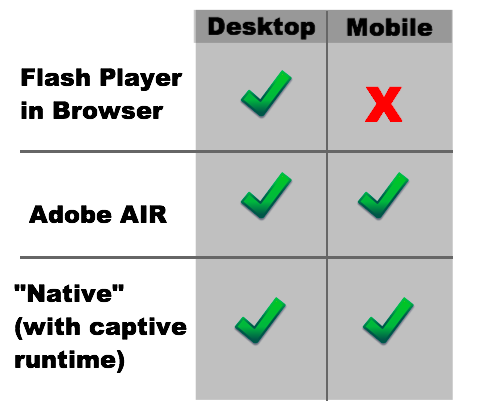
Yes, Adobe will stop development on the Flash Player in the Browser.
Flash Player on the mobile will continue.
Adobe AIR will continue, on the desktop and mobile.
Captive runtime of AIR allows to create “native” apps on mobile and tablets (Android, iOS and more) and desktop WIndows and OSX apps that don’t need AIR to be distributed. Yep, that continues too.
Of course Adobe tried to clarify their statements after the fact saying the transition to HTML5 will take 3 to 5 years. The following is from Adobe’s website from Andrew Shorten & Deepa Subramaniam, see: http://blogs.adobe.com/flex/2011/11/your-questions-about-flex.html
You said that you believe HTML is the “long-term solution for enterprise applications” – can you clarify this statement?
HTML5 related technologies (comprising HTML, JavaScript and CSS) are becoming increasingly capable, such that we have every reason to believe that advances in expressiveness (e.g. Canvas), performance (e.g. VM and GPU acceleration in many browsers) and application-related capabilities (e.g. offline storage, web workers) will continue at a rapid pace. In time (and depending upon your application, it could be 3-5 years from now), we believe HTML5 could support the majority of use cases where Flex is used today.
However, Flex has now, and for many years will continue to have, advantages over HTML5 for enterprise application development – in particular:
- Flex offers complete feature-level consistency across multiple platforms
- The Flex component set and programming model makes it extremely productive when building complex application user interfaces
- ActionScript is a mature language, suitable for large application development
- Supporting tools (both Adobe’s and third-party) offer a productive environment with respect to code editing, debugging and profiling
I guess Adobe’s communication just accelerated that 3 to 5 year timeframe by quite a bit.
Enjoy!
Daniel
Daniel Wanja
HTML5, iOS and Ruby On Rails Nouvelles Solutions, Inc.
d@n-so.com

